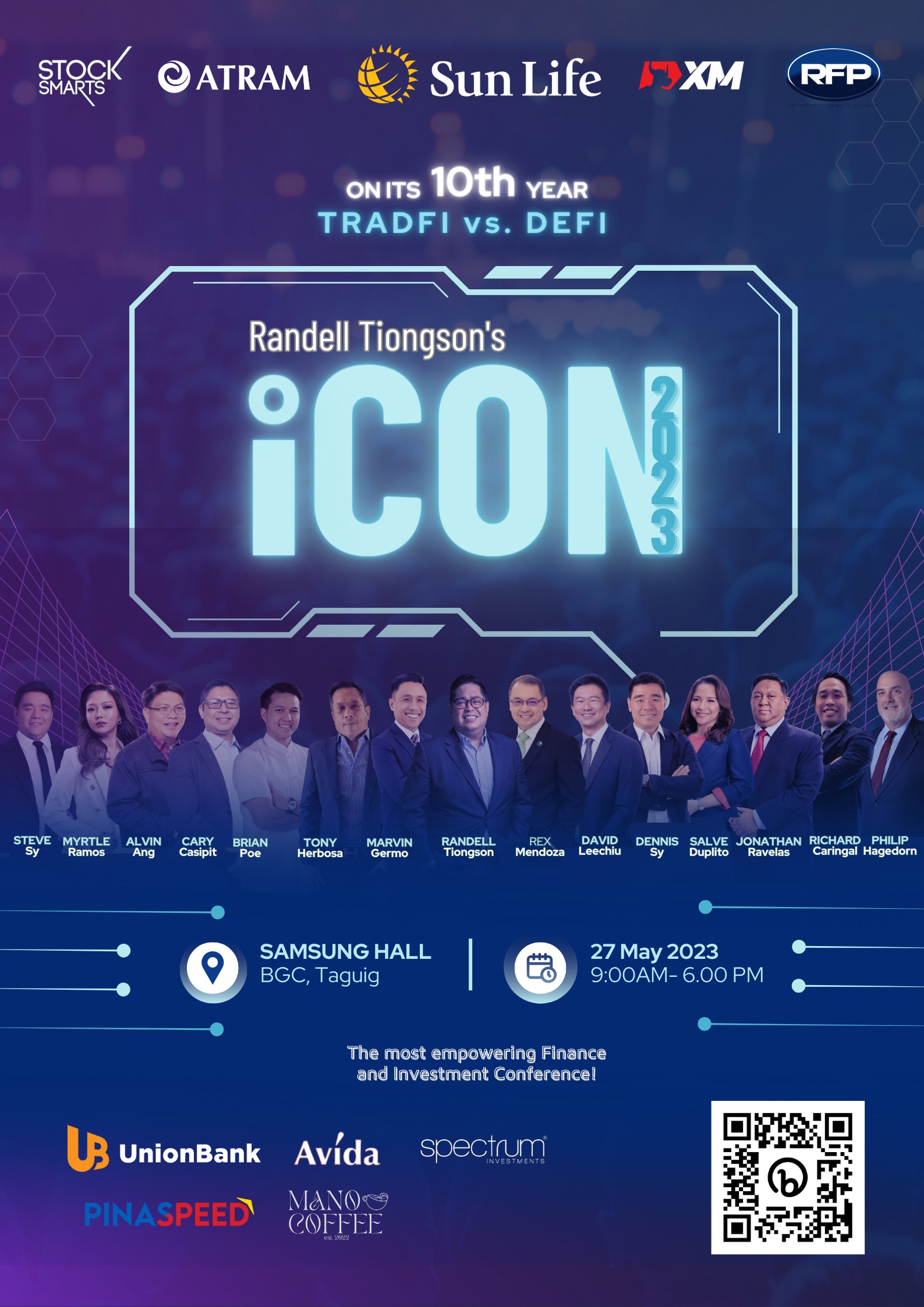
The world economy is entering a new normal, as we live in a world post covid with a new set of issues but in the midst of the crisis and the chaos still lies opportunity. Opportunity not just to survive but also to thrive. In this face to face conference we would talk about different opportunities to invest both from traditional investments and also from decentalized investments.
iCon was organized in the hope to further the financial and investment education of many Filipinos and it has stood out among similar conference because of quality, reach, content, roster and the like. #iCon does not only inform it’s audiences, it empowers them. Due to its success, #iCon is now running on its 10th year.
#iCon2023 continues its tradition of featuring the best minds of the industry but we are also featuring new and exciting additions this year.
It is not everyday that you will see an assembly with the best minds like this! It’s time to invest for your future. Join us this May 27, 2023 at the Samsung Hall at SM Aura, Taguig City from 9am to 6pm.
Registration is via bit.ly/3W4cw3c(with my special promo code for discounts) and if you prefer to pay via GCash, the payment link is via bit.ly/ICON2023GCASH. Check the link for our limited slots for early bird rates.
For Filipinos in the UAE: Money Talks 2023
By Randell Tiongson on February 7th, 2023
The most empowering finance and business conference for the Overseas Filipinos in the UAE is back! #MTUAE2023
If you are a Filipino based in the UAE, do not miss our 2-day conference that will help you build a better financial future.
Money Talks UAE 2023
Here’s what you can expect from this life-changing event:
DAY 1: March 18, 2023 at Two Seasons Hotel & Apartments, Dubai Internet City
BUILDING A STRONG FINANCIAL FUTURE with Randell Tiongson – a discussion on tried and tested sound principles on personal finance that will ensure a stable financial future for the Overseas Filipino. Randell is one of Ph’s leading thought leader in the area of personal finance.
TACTICAL INVESTING FOR THE CHANGING TIMES with Marvin Germo – a deeper discussion on tactical investing that covers stocks, cryptocurrencies and NFTs. Marvin is one of Ph’s leading influencers in the area of investing.
ENTREPRENEUR’s JOURNEY TO FRUITFULNESS with Dodong Cacanando – To succeed in business, you must first understand what entrepreneurship is about. The session will help you understand entrepreneurship in its simplest form so you can manage it properly. It will also explain that entrepreneurship is a journey, not a race, then show you what you need to do to enjoy and succeed in it. Dodong is one of Ph’s leading Business leaders and educator.
Day 2: March 19, 2023 at Hyatt Place, Al Rigga, Deira
TECHNICAL INVESTING with Marvin Germo – A deeper dive on the rudiments of technical investing that will help manage risks better and improve returns. Applicable for the stock market and cryptocurrency. This session will give you concrete understanding on the value of technical analysis.
FARM FOR PROFIT with DODONG CACANANDO – Most of our farmers have abandoned their land because they have not profited from it. And most of those who took over their land has lost a lot of money trying to make it productive. But this does not have to be so because farming could be very rewarding. It can also give you the income you need to live an abundant life after retirement. But first, you need to understand that farming is a business and that land is the most powerful asset anyone can have. This two-part program will first explain what farming is about and what a farmer needs to make his land productive and profitable.
Question: I’ve been thinking of carrying less cash and becoming more cash-lite but I am not savvy enough to see my money on my smartphone rather than wallet. I’m not confident enough without my tangible asset. I am 42 years old and my kids are telling me to go online to manage our business. What is your advice?
Answer: Congratulations on that huge step of considering to go cash-lite! We all need that nudge from our children and peers. I fully understand that comfort of seeing your money within reach — whether be it in your wallet, safe or hidden under your pillows. Since you are managing a business, may I suggest that you opt for a cashless platform that can streamline your business.
Everywhere in the world, we are seeing societies move towards going cashless. Take a trip to a developed country and you’ll see that it’s more common to see residents paying with their cards or e-wallets instead of bills and coins like in Canada or China.
In the Philippines, although it is still an emerging economy, we are not far from becoming more cash-lite. In Asia, the Philippines is one of the hubs for online shopping. In fact, earlier this year, Visa conducted a Consumer Payments Attitudes Study, which revealed more and more Filipinos are going cashless due to its convenience.
The survey added that in 2018, more Filipinos use digital payments and are spending 15% more on their cards than they did in 2017. Of the survey respondents, 92% said that they shop online compared to 71% just two years ago. For majority of them, online shopping has become more than a once-a-month habit. The survey also found that Filipinos use online payments for their utility bills, clothes shopping, food delivery, and online streaming.
Looking at your situation, it appears that you have a conservative approach when it comes to digital transaction. While there are many payment providers nowadays, it is advisable that you check what are the latest digital banking options that your bank current offers.
Most if not all banks in the Philippines are now EMV-enabled meaning even if you’re not tech savvy enough, you can use your bank’s ATM or Credit card to facilitate online bank transaction including payment and money transfer. Top banks like BDO, BPI, and Metrobank have their own respective app you can download where you can keep track of your transaction and check your balances.
While the big three may be the obvious choices for newbies, there are banks like Security Bank that is ahead among the pack when it comes to offering online products and services catered to streamline business operations.
The bank caught my attention when it was named the Best Bank in the Philippines for 2018 by no other than New York-based Global Finance. The awarding body said that regardless of the bank’s size, Security Bank’s online banking service triumphed over the Big Three Banks.
The bank has upgraded its mobile app interface, allowing a seamless banking transaction from checking one’s account balance to transferring funds. It also has an eGive Cash feature, which allows real-time fund transfer from an account holder to its recipient, regardless if the receiver is a Security Bank account holder or not. eGive Cash can be withdrawn from any of Security Bank’s ATM.
Lastly, the one that is perfect for any businessman is the bank’s Digibanker platform. With high approval ratings, the platform houses a one-stop shop for bills payment, streamlining processes for your business’ financial obligations. It simplifies the payment of bills different deadlines, keeps track of undelivered check payments, and offers tax forms. Now you can go cash-lite and paperless at the same time.
Going cash-lite isn’t as scary as it is. It is important to examine, understand and find the right partner for your needs. As time goes by, a lot of platforms spring out as fast as mushrooms but instead of being intimidated.. embrace it!
Want to learn how to manage your finances better?
Register now and get a free copy of my e-book. Start your financial planning journey today!